
04

Foujita’s Definitive Return to the West

With Kimiyo: The Flight to Freedom, Rebirth in New York

1949

Finally obtaining his visa, Foujita flew to New York on March 10. On May 23, Kimiyo joined him. Appointed professor at the Brooklyn School of Fine Arts, he would never teach there, dedicating himself entirely to rebuilding his life by embarking on paintings with perfect glazes and very French subjects. His series of canvases in homage to Jean de la Fontaine, exhibited at the Mathias Komor Gallery, is a marvel. Foujita is reborn.

The Definitive Return to Montparnasse

1950

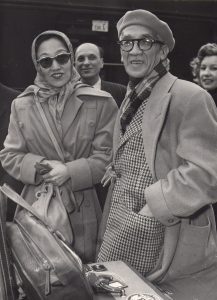
Foujita's Arrival in Paris, 1950
Foujita’s Arrival in Paris, 1950

On January 27, he embarked with Kimiyo on the S.S. Washington, disembarking in Le Havre on February 14. In Paris, Foujita declared to journalists:

I am returning to stay. I want to die in France and be buried in Montparnasse Cemetery next to Modigliani.

After a stay at the Beaujolais hotel and leaving his trunks with his friends Grosjean, Foujita found a studio at 23 rue Campagne-Première in Montparnasse, which, however, had lost its pre-war effervescence. He remained faithful to Figuration while Abstraction had invaded galleries in France. In March, he exhibited at the Paul Pétridès gallery, which would dedicate an exhibition to him every two years until 1964.
1951

At the end of January, his friend Victor Berger-Vachon invited him to his home in Bouzaréa, while Romanet exhibited his work in his gallery on rue d’Isly, in Algiers, then in Oran and Casablanca. In November, it was at the Círculo de Bellas Artes in Madrid. The couple’s financial ease was once again assured. Foujita participated in the first “Salon des peintres témoins de leur temps” (Salon of Painters Witnessing Their Time). He would exhibit there for eight years.

1952

Foujita donated four important works to the National Museum of Modern Art: My Interior (1921), My Interior (1922), Café (1949), Notre-Dame, Quai aux fleurs (1950). In June, his second exhibition opened at the Paul Pétridès gallery.

1953

In the autumn, two exhibitions were dedicated to him in Barcelona and Bilbao. They were great successes.

1954

The 3rd exhibition at Paul Pétridès took place in July. On October 5, Foujita, who had officially divorced Youki a few months earlier, married Kimiyo privately.

Always with Kimiyo: Naturalization and Religious Illumination

1955

On February 28, they obtained French nationality. In March, the Bridgestone Museum of Art in Tokyo organized a special exhibition of Foujita, who, in France, illustrated Jean Cocteau’s Le Dragon des mers, an account of the famous writer’s trip to Japan.

1956

In July, a new exhibition opened at the Paul Pétridès gallery. There, he met René Lalou, president of Champagnes Mumm, for whom he would design a rose, the emblem of their rosé cuvée.

1957

Foujita was promoted to the rank of Officer of the Legion of Honor.

1958

Elected associate member of the Royal Academy of Belgium, his exhibitions multiplied throughout Europe. In Reims, where he stayed at the invitation of René Lalou and Georges Prade, he claimed to have received mystical illumination while visiting the Basilica of Saint Remi.

1959

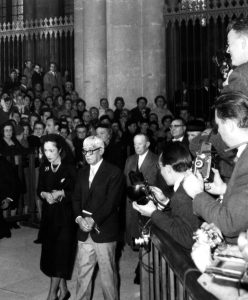
Foujita, Baptism in Reims, 1959

The illustration of The Apocalypse of Saint John, commissioned by publisher Joseph Forêt with Salvador Dalí, Bernard Buffet, Ossip Zadkine, Jean Cocteau, Jean Rostand, and Ernst Jünger, strengthened his religious consciousness. On October 14, converted to Catholicism, Foujita and Kimiyo were baptized and religiously married with great pomp in Reims Cathedral. The painter adopted the first name Léonard, in homage to Vinci, and henceforth signed his works this way.
1960

The painter acquired a small house in the village of Villiers-le-Bâcle (Essonne), overlooking the Chevreuse valley. He undertook extensive renovations, which he directed himself. Foujita regularly worked for publisher Pierre de Tartas, who had created the Vauboyen art center in Bièvres (Essonne).

1961

He participated in the first exhibition of sacred art in Trieste (Italy) and received the gold medal there. In November, he moved to Villiers-le-Bâcle, while keeping his studio on rue Campagne-Première. Exhibitions continued to follow one another in both France and Japan.

1962

He planned to build a chapel in Villiers-le-Bâcle and sought land for his project. He began to create small models.

1963

He created the illustrations for La Mésangère based on a text by Jean Cocteau, published by Pierre de Tartas, the last work written by the poet who passed away shortly after.

1964-1966

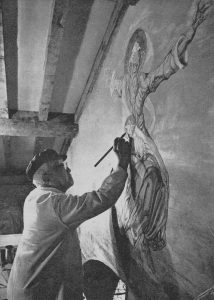
Foujita, Chapel in Reims, 1966

Foujita dedicated all his energy to his last great work, the Notre-Dame-de-la-Paix Chapel in Reims. He designed the plans, in conjunction with architect Maurice Clauzier, and the drawings for the stained glass windows, ironwork, sculptures, and created an immense mural painting on all the interior walls. René Lalou, president of the Mumm house, personally financed the construction. In May 1966, the chapel was built, and the following summer, it was frescoed by Foujita. On October 1, the edifice was consecrated, and on October 18, Foujita and René Lalou handed over the keys to the city of Reims.

1967

The painter’s health was concerning. Suffering from cancer, he was first treated in Paris, then, on the advice of his friend Georges Prade, cared for by the eminent Professor Rossier at the Cantonal Hospital of Zurich. He underwent several operations there, allowing him to return to Villiers several times, but the disease inexorably claimed him at the end of the year.

1967

On January 29, after immense suffering, he passed away in Zurich, leaving behind an imposing body of work in Paris and worldwide. He rests in Reims in his chapel alongside his last wife.