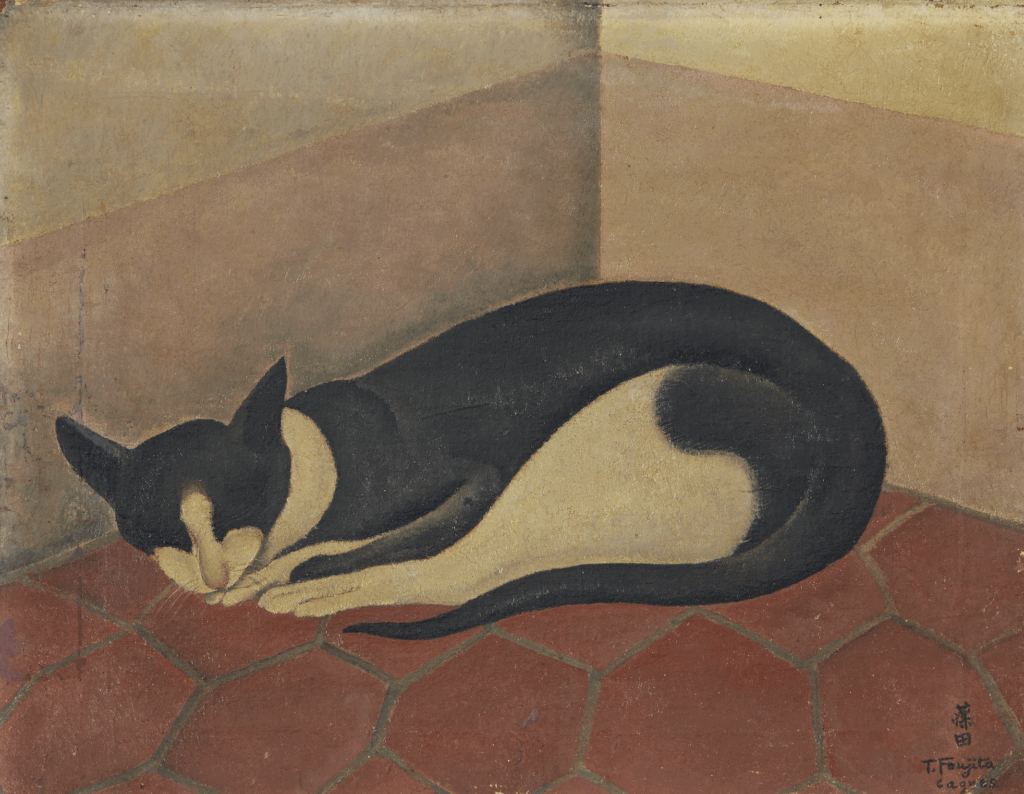
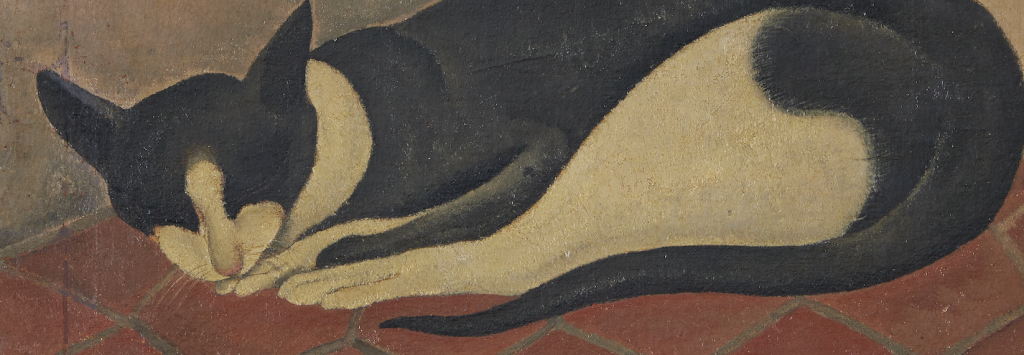
The Château-Musée de Cagnes, represented by its director Emeric Pinkowicz, curator of the Cagnes city museums, pre-empted at Biarritz-Enchères, on Saturday, August 9, from Élisabeth Maréchaux, the sale’s expert, to our great delight, this painting by Foujita depicting a black and white cat asleep in the corner of a room paved with Provençal terracotta tiles, decorated according to local tradition with a pink colored strip serving as a baseboard.
The setting for the historic stay Foujita made with his wife Fernande in the heights of Cagnes, far from the war raging in Eastern France and in Paris itself in the spring of 1918, is depicted here.
It is difficult to say whether the cat depicted here is sleeping in the very house that Léopold Zborowski, a poet but above all an art dealer, rented in Cagnes to stay with his formidable team—Amedeo Modigliani and his partner Jeanne, then expecting her first child; Chaim Soutine; Tsuguharu and Fernande Foujita; his wife Hanka Zborowska; and Jeanne Hébuterne’s mother, Eudoxie, concerned about her daughter’s health—or elsewhere in the village.
This charming place overlooking the Mediterranean allowed the three artists to venture out together, easel in hand, to discover and appreciate common painting motifs. Curiously, Modigliani painted the only landscapes of his life in France there, undoubtedly influenced by Soutine and Foujita. All of them created portraits of children, villagers, and village women. Colorful, tranquil scenes, far from Montparnasse. The idea of their dealer, who was at the time crisscrossing the palaces of Cannes and Nice on the French Riviera, was to sell their paintings to wealthy collectors who had taken refuge by the sea, far from Paris.
It was not so simple, as the team had to move out discreetly, no longer able to pay their last rents to the landlord, known as Père Curel, to whom they generously offered paintings in exchange for rent, which he had refused. It goes without saying that he quickly and bitterly regretted it!
One of these paintings is therefore returning to its original location, and we are delighted. A cat whose fur obviously evokes the Zen sign of Yin and Yang, perceived by the Japanese painter, luminous in his eyes in the Provençal shade and coolness.
The painting was published in 2007 in Volume 3 of the Catalogue général Raisonné, titled “Foujita inédits” by Sylvie Buisson. Co-published by À l’encre rouge, Archives Artistiques, and Fondation Nichido, page 92.