
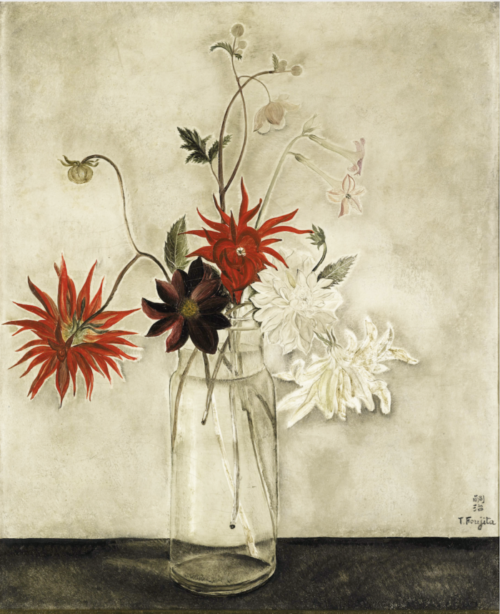

A hundred years ago, in 1921, Foujita developed what he considered a revolutionary technique: coating the background of his oil paintings with a thick, smooth, white paste, which allowed him to draw fine lines with a very thin brush, using black paint diluted with oil or water, on this smooth surface, as porous as Japanese paper. He was thus able to draw with the tip of his brush outlines of remarkable delicacy and precision, particularly those of female anatomies. But not only these, as animals, children, and flowers were also his favorite subjects, and he excelled at depicting them down to the smallest detail.
I realized that I had been a prisoner of my teachers’ instruction. Regarding the color black, my predecessors had already achieved the maximum, so I would never have surpassed them. Therefore, I tackled white, which is the opposite of black. White is mainly used in chiaroscuro, reflections, and to express perspective, but I wanted to use this white as such on my canvas, to express its beauty. [Foujita – His presentation to students of the Tokyo School of Fine Arts, in 1929.]
This layer of milky white color that Foujita spread on his canvas is called hakushoku – 乳白 in Japanese. It has the color of milk, which in Japan, is extracted from soy. Before arriving in Paris, the painter drank only this less fatty, equally nutritious plant milk, which becomes tofu – of the same color – after coagulation.[1] Tofu precisely has the light color of the backgrounds in Foujita’s paintings. The color is indeed more amber than that of cow’s milk. The consistency is thicker, creamier. Foujita allows it to largely show through once the painting is finished. He loves this white background; he does not obscure it. It breathes, and the painting lives!
[1] Tofu dates back 164 years before Christ. The Chinese philosopher, politician, alchemist, and Taoist, Lord Liu An of Huainan, is its inventor. Tofu enriched the vegetarian diet of his Taoist friends.