
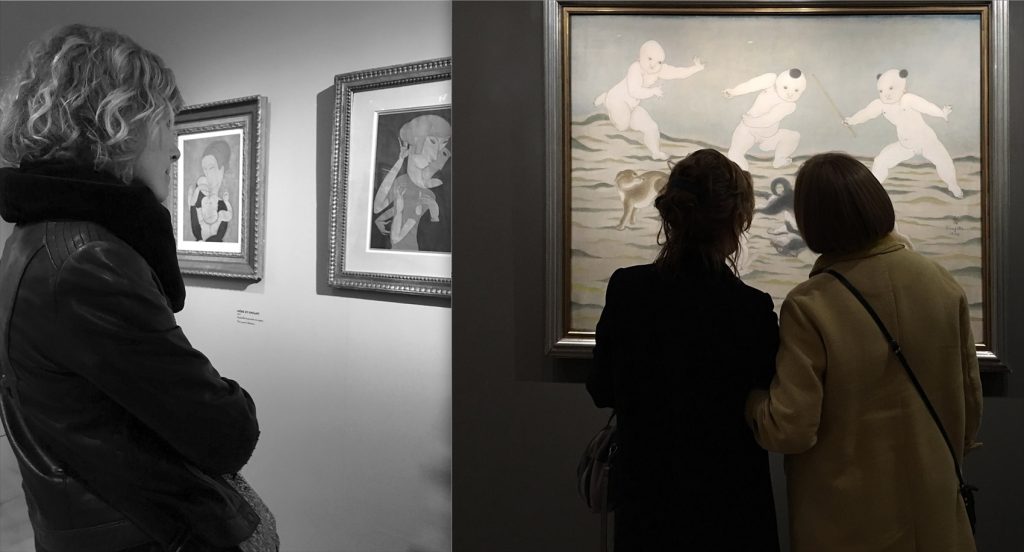
From March 7 to July 15, 2018, the Maillol Museum presents the first Parisian exhibition dedicated to the Japanese artist [naturalized French] Léonard-Tsuguharu Foujita. 150 major works from public and private collections trace the exceptional character of Foujita’s Roaring Twenties in Montparnasse, surrounded by his friends Modigliani, Zadkine, Soutine, Indenbaum, Kisling, and Pascin. The exhibition focuses on the artist’s first Parisian period, a highly productive time between 1913 and 1931.
The exhibition traces the story of a unique destiny, that of an artist evolving between two cultures. From his beginnings in Japan, through his rise and the revelation of his work, his journey led him to the creation of this singular persona in the Parisian context of the Roaring Twenties. His favorite themes – women, cats, still lifes, children, and self-portraits – are specific to the abundance of his artistic production. Foujita, respectful of his Japanese roots and the classicism of the great Western masters, invented an inimitable art combining East and West.
His works call upon others, those of his studio neighbors, his friends, for an enriching dialogue that allows us to measure the originality and complementarity of these figurative artists, foreign and French, grouped under the name of the School of Paris.
The works from remarkable institutions and museums, combined with a hundred other rare pieces from some 45 private collections from Japan, the United States, and Europe, contribute to highlighting Foujita’s extraordinary creative genius and inviting visitors to discover the intimacy of a surprising man. The monumental diptychs, Combats I and II and Compositions with Lion and Dogs from 1928, [Essonne Departmental Council] and the 4 gold-backed panels from the Cercle de l’Union interalliée, at the heart of the exhibition, demonstrate Foujita’s virtuoso power and the impact he had on his era. The exhibition demonstrates the talent of the artist, a drawing enthusiast who, like his illustrious predecessor Hokusai, masterfully handled the brush and the spirit of drawing. Foujita’s line is unfailingly precise, and his lines, drawn with incredibly fine calligraphic Japanese black ink Sumi, are also combined with oil on canvas. The color glazes play a decisive role in enhancing the line. On paper, the delicacy of gouache and watercolor, initially flat, then more nuanced, provides subtle transparencies similar to those of oil paintings. The gold backgrounds further reinforce the impression of preciousness, religiosity, and refinement.
Fifty years after Léonard Foujita’s death in 1968, the Maillol Museum honors the luminous and rare work of the most oriental of Montparnasse painters.
N.B. / Practical information: http://museemaillol.com