01

Childhood, Adolescence, and the Beginning of an Occidentalist Career in Japan

A Traditional Childhood in Japan Marked by His Mother's Death

1886

Tsuguharu Foujita was born on November 27, 1886, in Tokyo, during the reign of Emperor Meiji.

Descended from the aristocracy on both his father Tsuguakira’s and his mother Masa’s sides, the child was raised with respect for Japanese traditions within a family particularly open to Western ideas. Tsuguakira, a doctor and army general, and his wife raised their three children—two daughters, Yasu and Kiku, and one son, Tsuguo—with respect for tradition, nature, and also innovation, to which the youngest of the four children, Tsuguharu, would prove to be the most receptive.

1891

Masa died one summer evening on the island of Kyūshū, in Kumamoto, a garrison town where the family had resided for three years. This tragedy prompted Tsuguharu to invent a better world, to his liking. He sketched images of his dreams of escape in a small notebook. He invented and took refuge in a place he had not yet located. He continued his elementary schooling in Kumamoto, meticulously drawing boats and military battles, and escaped through drawing.

An Adolescence Illuminated by Drawing and Paris

1900

Upon returning to Tokyo, he enrolled in the college of the Higher Normal School and informed his father of his decision to become a painter. In return, he received the money needed to purchase his first materials. His painting was selected to be exhibited at the Paris Universal Exposition.

He visited an exhibition of Western art in Tokyo and was captivated by a Claude Monet painting; he dreamed of getting to know France.

One beautiful sunny day, all the books were displayed on the straw mats, and my brother was reading, stretched out. I was overjoyed with their engravings.

1903

He enrolled in French language courses offered in the evenings at the École de l’Étoile du Matin in Tokyo. In reality, he was preparing himself to fulfill his dream.

1905

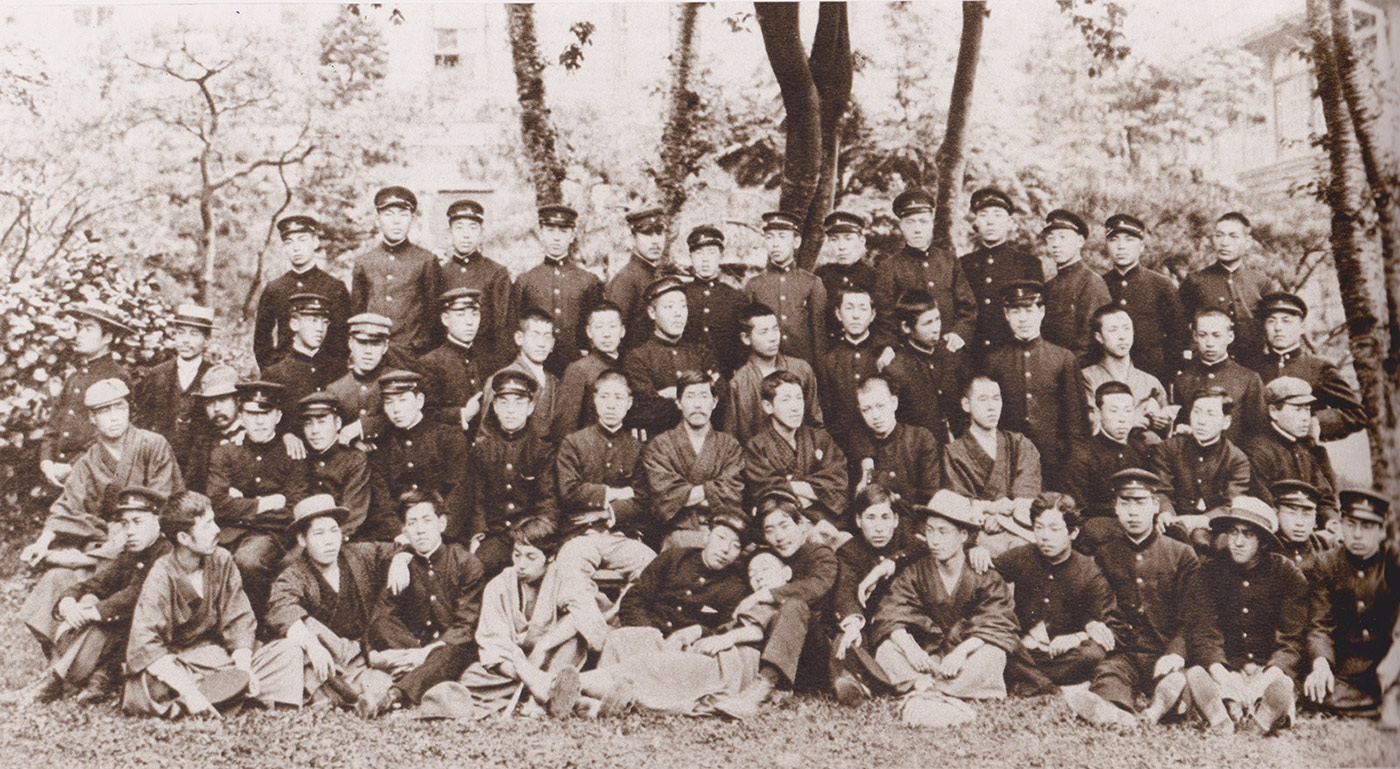
Foujita's Adolescence, School Photograph

With his high school diploma in hand, he prepared for the entrance exam to the Tokyo School of Fine Arts in the studio of painter Honda Kinkishirō (1850-1921), opting for the section directed by Kuroda Seiki (1866-1924), a pioneer of Western-style painting, Yōga, after having studied the fundamentals of traditional Japanese painting.

1906

He traveled to China and Manchuria. He studied in a class for gifted students at the Beaux-Arts.

1910

He received his diploma in oil painting (Yōga section) with a passing grade. Deeply disappointed, he thought only of leaving for France, but his father obliged him to persevere in Japan and build solid connections within official circles.

He exhibited at the 13th White Horse Salon but was refused entry to the official Bunten Salon three times. The young painter, deemed too unconventional, took offense.

An Early Occidentalist Career in Japan

1911

He assisted his professor Wada Eisaku (1874-1959) in creating the mural decoration for the Imperial Theatre of Tokyo (destroyed during the 1923 earthquake) and painted the portrait of the exiled Emperor of Korea. His career began conventionally, but he grew impatient as his dearest wish was still to go to Paris. He met Tomi Tokita, a young woman he decided to marry, and became officially engaged to her.

1912

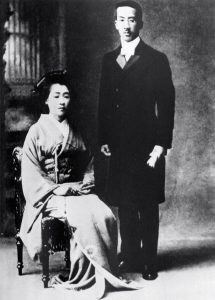
Tomiko and Tsuguharu Foujita, on their engagement day, 1912

A young textile art student and teacher of the same age, she shared a great complicity with him, and soon a house on the Chiba peninsula where his parents resided. There, a small community of artists formed around her and Foujita, with whom they led a very original, even somewhat scandalous, bohemian life for traditional provincial Japan.

1913

Foujita finally obtained permission to leave Japan for a three-year study trip; he embarked on June 18 and arrived in Paris on August 6.