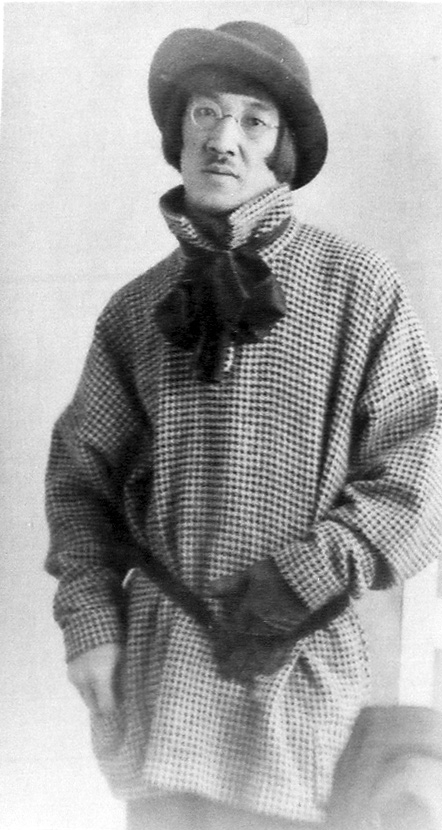
Settled at the Hôtel Odessa, the painter Manuel Ortiz de Zarate took him to Picasso’s studio the next day. Within a few days, this visit brought him into the heart of the avant-garde. He also visited the Louvre, attended the Salon d’Automne, and began to observe, painting very little. He decided to abandon everything he had learned in Tokyo and start from scratch. His compatriot, the painter Kawashima Riishirō (1886-1971), introduced him to the Académie Duncan and assisted him in his various discoveries and experiments. By autumn, he moved to 14 Cité Falguière, thanks to Modigliani and Soutine. He assiduously frequented the Louvre, traveled to London in December, returned to Paris, and maintained a rich correspondence with Tomi, describing life in Paris and strongly urging her presence.
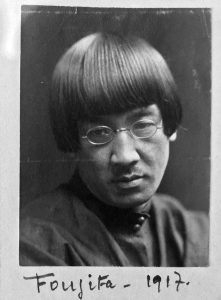 In January, back in Paris, he informed his father that he was staying in Paris for his career and asked him to break off his engagement. Furthermore, he met a young painter, Fernande Barrey (1893-1974), at La Rotonde; he married her immediately and moved into her home at 5 Rue Delambre. Together, they organized a first exhibition of 110 watercolors in June and another of over a hundred works in November at Galerie Cheron, the dealer for Chaïm Soutine and Amedeo Modigliani, on Rue de la Boétie. He achieved great success and a contract. Foujita successfully blended East and West in his paintings.
In April, Foujita and Fernande stayed in Cagnes with Soutine and Modigliani at the invitation of the dealer Léopold Zborowski in a small house near Les Collettes, where they met Auguste Renoir at the end of his life. The encounter was memorable. The stay was foundational for Foujita. In November, back in Paris, he exhibited at the Devambez gallery. His success grew, critics praised the Japanese artist of Montparnasse and lauded his suburban landscapes inspired by Douanier Rousseau.
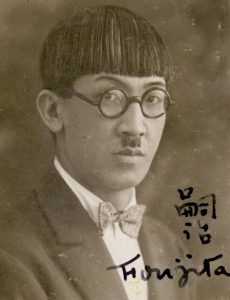
For the first time, he presented two large-format paintings at the Teiten Salon in Tokyo, Mon Intérieur and Nature morte au réveil matin (Still Life with Alarm Clock), works exhibited the previous year at the Salon d’Automne. His father was proud. The Royal Museum of Fine Arts of Brussels acquired Mon portrait, the first state acquisition.
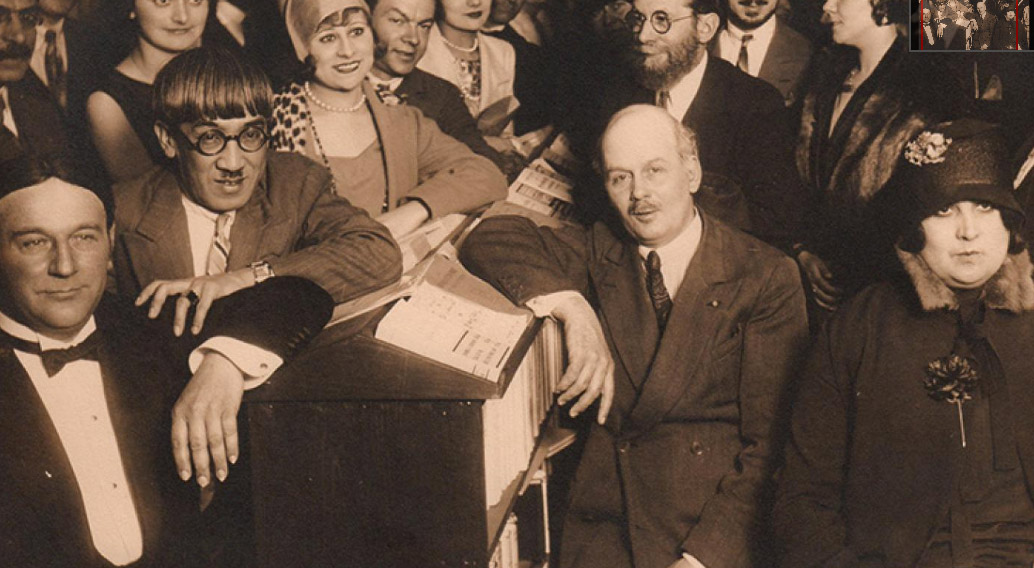
Foujita received numerous portrait commissions and was the subject of a first monograph by Michel Vaucaire (1904-1980). A Knight of the Legion of Honor in France, he was also made a Knight of the Order of Leopold I in Belgium. The summer was spent at Les Sables Blancs.
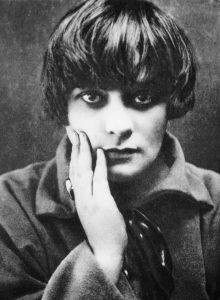
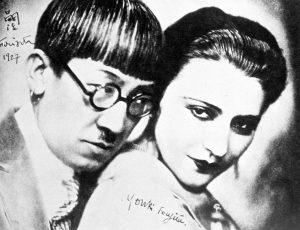
Undoubtedly his most productive year, the commission from patron Satsuma Jirohachi for the decoration of the Maison du Japon at the Cité internationale universitaire de Paris—two monumental diptychs, Grande Composition and Combats, presented at Bernheim-Jeune, and their cohort of preparatory drawings—did not prevent him from creating numerous nudes, cats, children, illustrations, and engravings. The couple moved to Square Montsouris near Georges Braque and André Derain. Thanks to Youki, Foujita discovered surrealist ideas and Robert Desnos. Calder presented his Cirque at their home during a memorable evening. The summer was spent with friends in Deauville and Bréhat.
With his studio closer to Montparnasse, the painter received more visitors and models, including Jacqueline Barsotti, whom he shared with Man Ray. Located on the top floor of his Art Deco villa, his spacious workspace opened onto a pleasant balcony where he posed for photographer Andrès Kertész. He himself acquired an ultra-modern Kodak camera, with which he filmed scenes of his models and especially Yuki.
At the 1st Salon of Japanese Artists in Paris, Galerie La Renaissance, he presented his monumental gold-background work L’Arrivée des Occidentaux au Japon (The Arrival of Westerners in Japan), intended for the Maison du Japon, and undertook a series of eight gold panels for the Cercle de l’Union Interalliée on Rue du Faubourg Saint-Honoré. He presented Combats and Grande Composition, paintings rejected by Baron Satsuma, at the Musée du Jeu de Paume. He decided to marry Youki. His production intensified, focusing on children, cats, and still lifes, until his departure for Japan in September.
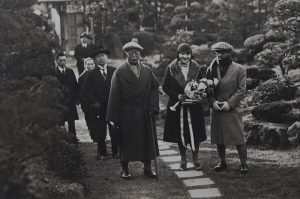
The Asahi Shimbun newspaper scheduled major exhibitions in Tokyo, Osaka, and Fukuoka, all of which were successful. Youki met his father, brother, and sisters—a return to his roots, certainly prompted by a tax adjustment, but one that filled them with happiness, immortalized by his 18mm Kodak camera.