
02

World Travels and Return to Japan

With Madeleine: Travels

1931-1933

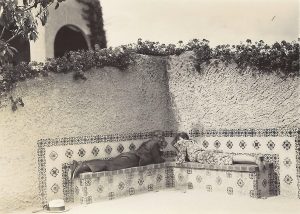
Foujita and Madeleine in Mexico, 1933

The journey through Latin America lasted over two years, paved with successes and wonderful encounters. All paintings created from Madeleine posing and photographs of indigenous people were acquired by top collections. After a stop on the West Coast of the United States, they reached Japan in November 1933 with a substantial sum and settled in Tokyo, where Foujita soon after had a Mexican-style house built in his sister’s garden.
1934

{%ALT_TEXT%}
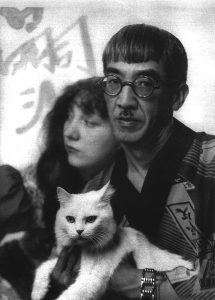
Foujita and Madeleine, Tokyo, 1934

The new Nichido Gallery in Ginza committed to exhibiting the painter, of whom all Tokyo spoke, annually for four years. The Nika Salon invited him. He created a large mural for the Café do Brasil in Ginza and responded to numerous commissions for society portraits.
1935

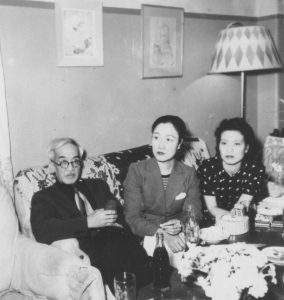
The Sogo department store in Osaka and the large Colomban café in Tokyo entrusted him with the creation of two monumental French-style paintings. Foujita excelled in this style, so exotic in Japan. Madeleine, who had returned to France for some time, was unpleasantly surprised to learn that, in her absence, Foujita had been frequenting a young and pretty Japanese woman in Tokyo.

1936

Upon her return, their relationship deteriorated. They traveled to China. Foujita participated in the exhibition “Ten Great Masters of Western Painting” organized by the Shiseido store in Ginza, created two décors in Kyoto—one for the Marubutsu department store, the other for the Franco-Japanese Institute of Kansai—while Madeleine performed and found distraction at the Takarazuka theater. The young Japanese woman, Kimiyo Horiuchi, took care of the house. In June, Madeleine died suddenly in Tokyo at only thirty years old; drugs and alcohol had taken their toll.

With Kimiyo: Japan Above All

1937

To find a distraction from his grief, Foujita threw himself into his work, taking on a challenge from collector Hirano Seikichi to paint the world’s largest painting (3.65 x 20.50 m), depicting the Akita Four Seasons Festivals, which he completed in just 174 hours.

1938

A beneficial stay in Okinawa reintroduced color into his subjects, landscapes, and peasant scenes of island life, as he had handled it in Latin America.

In September, Foujita married Kimiyo; he received orders from the Ministry of the Navy to follow the battles taking place in China as a painter attached to the armies. Foujita produced battle sketches and later the oil on canvas entitled The Conflagration of the New Nanchang Airfield.

1905

Foujita in Paris, Rue Ordener, 1939

Frightened by the belligerent climate in Japan, Foujita returned to France with Kimiyo in search of peace. They settled in Montmartre, 138 Rue Ordener, in May. The summer was spent in Dordogne with painter Inokuma Genichiro (1902-1993). He reconnected with Marcelle Houry, known as Oury (1894-1980), a journalist and great friend of Raoul Dufy, and Jeanne Bernard, a former saleswoman at the Chéron gallery, who helped him re-establish himself by commissioning works. He primarily associated with the Japanese community in Paris, including painter Oguiss Takanori (1901-1986) and his wife.

19040

With the Germans at the gates of Paris, Foujita and Kimiyo embarked on a liner departing from Bordeaux on May 23 with all their Japanese friends. The code of honor and his father called him back to Tokyo, where he was appointed head of the official painters of the Imperial Japanese Army for the Greater East Asia War.

War Painting in Japan

1941

General Foujita died in May. In July, Foujita became a member of the Teikoku Geijutsu Imperial Academy of Fine Arts. In October, appointed by the Academy and the Association for the Promotion of International Culture, he was sent to French Indochina as a cultural attaché. He was tasked with organizing an exhibition in Hanoi (Vietnam), then in December in Phnom Penh (Cambodia).
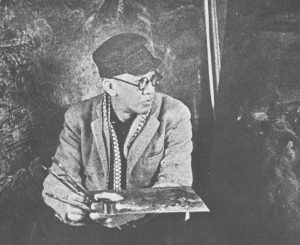
Foujita in his studio in Kojimachi, Tokyo, 1941

1942

In May, the Navy sent him to the South Pacific front as an officer and head of the official painters’ group. He participated in numerous exhibitions dedicated to the war and the Japanese army and published an essay titled Swimming on Land.

1943

In January, he received the cultural prize from the Asahi Shimbun newspaper.

1944

At the end of the year, he left Tokyo and settled with Kimiyo and a few painter friends in the small village of Hobuchi-Mura in the Kanagawa mountains.

1945

On April 13, his house and studio were destroyed in the bombing of Tokyo.

1946

In February, Foujita and Kimiyo were joined by American occupation troops who brought them and their friends back to the devastated capital. The “Arts and Monuments Section” led by Frank Sherman under General MacArthur proved to be of great help to Foujita. Targeted by a settling of scores from his former colleagues in the army’s painting corps, he was supported by French journalist Georges Grosjean and Frank Sherman, both of whom had known Foujita in Montparnasse and were convinced of his innocence. Foujita wished to leave Japan permanently. His friends worked to obtain an exit visa for him. This was a long and arduous process for him and especially for his wife, who was young and fragile due to the events.

1947

In May, Foujita presented My Dream at the Tokyo Contemporary Art Exhibition. In the autumn, he sent works to New York, where two solo exhibitions were dedicated to him at the Kennedy and Manhattan galleries. These exhibitions received favorable reviews. He was also a jury member for the Nichiten Academic Salon and designed covers for the Josei and Fujin Koron magazines.

1947

In October, he participated with My Studio (1936) in the “Total Exhibition of Modern Japanese Art.” In November, the Shiseido Gallery in Ginza dedicated an exhibition to him.

Foujita frequented General MacArthur’s entourage and often took refuge at the American HQ. The wait was long, and he had lost his taste for painting.